
There is a significant gap in the recognition of merit and authorship between women and men in the scientific community. This gap may be partly due to the fact that women’s contributions often go unnoticed or underestimated.
It is important to note that this gender gap is present in most scientific fields and at all stages of a career. And this is becoming a serious problem for women seeking to realize themselves in the scientific field. In this article, we look at what the problem is, what it is expressed in, and what solutions exist.
Systemic discrimination against women in STEM

Image: cz.usembassy.gov
In today’s world, research positions in STEM academic fields (Science, Technology, Engineering & Math) have become more accessible to women. According to a study published in the journal Proceedings of the National Academy of Sciences of the United States of America, women successfully do their jobs by publishing at the same rate as men. At the same time, they have about the same impact with their research. However, their careers are often less productive due to the higher dropout rate.
Also, due to historical barriers in the form of legal, social, and cultural barriers, STEM education and work are traditionally associated with men. And systemic discrimination, unconscious bias, and sexual harassment can prematurely end women’s careers in this field.
The Matilda Effect

Image: au.babor.com
There is a term used to describe the phenomenon when women’s scientific achievements are underestimated or not given due recognition—the Matilda effect. This effect may manifest itself in the fact that women are less likely to receive remuneration for their scientific research, publications, and other achievements in comparison with their male counterparts.
The Matilda effect has emerged due to the structural and sociocultural barriers that women face in the scientific field. Because of stereotypes about women as less capable and competent in science and because of the disparity of opportunities and support, women often find themselves at a disadvantage when evaluating their scientific achievements.
This phenomenon can lead to women receiving fewer opportunities for professional growth, funding, and recognition for their work. This creates additional obstacles for women in the scientific field and can lead to their isolation and lagging behind their male colleagues.
There are many examples in world history that the contribution of women scientists is often underestimated. Sometimes the authorship of articles and the primacy in scientific discoveries are unfairly assigned to men. Many people know the story of Marie Sklodowska-Curie, one of the discoverers of radioactivity. Besides her, there were many other women who made contributions to science but did not immediately receive recognition.
Of the most famous scientists, we know Nettie Maria Stevens, one of the first American women geneticists, who became the first researcher of the sexual X and Y chromosomes, along with another scientist. Many people are familiar with the story of Susan Jocelyn Bell Burnell, the discoverer of a new class of astronomical objects—pulsars.
These and many other women have faced discrimination in the scientific community. How many women’s contributions were missed under similar but less high-profile circumstances? And how many women have lost all incentive to pursue a career in science as a result?
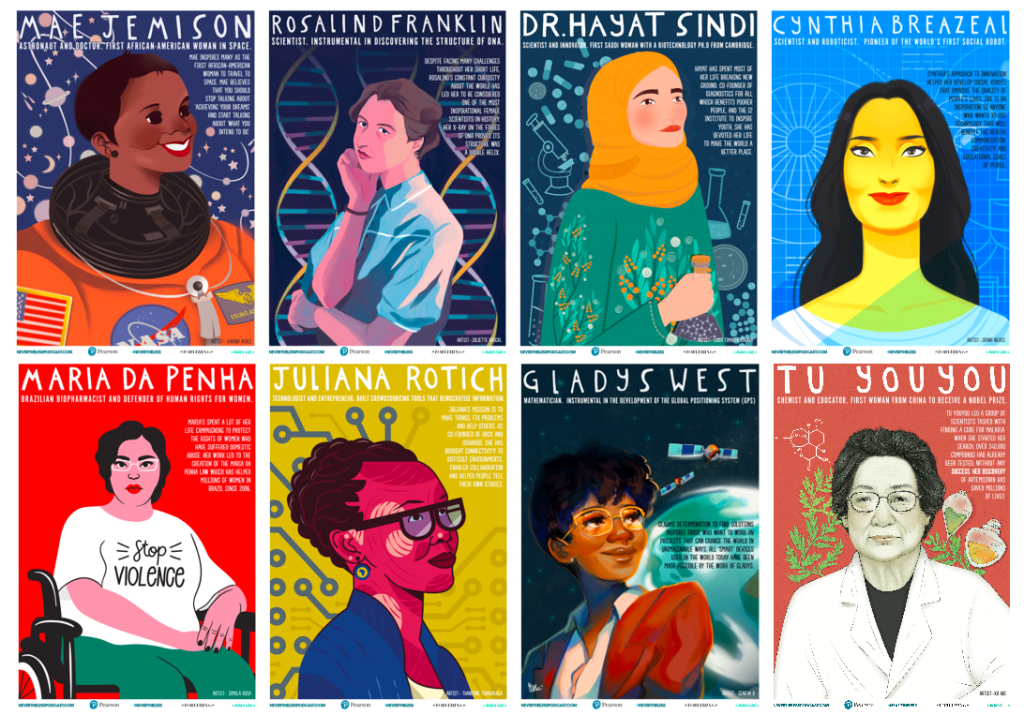
Image: sustainabledevelopment.un.org
Why don’t women get enough attention in science?
In 2022, a study was published in the journal Nature on the topic that women in science receive less attention than men. The gap in recognition between male and female scientists may be related to differences in productivity or how women’s contributions are recognized. Women may be less productive because they work in a less favorable work environment, have more family responsibilities, and hold different positions in the laboratory.
But recent research has shown that women are not less productive, but rather, their work is underestimated. Scientists have found that at least part of the observed gender difference is related to how women’s contributions to scientific work are evaluated and recognized.
The results are supported by three different data sources:
- Large-scale administrative data on research groups and attribution of merit. Their analysis shows that women in the team are significantly less frequently mentioned than their male colleagues.
- Extensive survey of authors. It shows that a woman’s contribution to science is recognized less often.
- High-quality answers. According to them, it can be assumed that the reason that women are less likely to receive recognition may be that their work is often not known, not appreciated, or ignored.
The significance of the problem
According to the study, there are a number of points that directly indicate that there is a problem of discrimination against women in the scientific community.
- Women are less likely to be named as the authors of any document.
- Women occupy lower career positions than men.
- Women are much less often mentioned in influential and significant articles.
- Women are more likely to report that their contributions have been underestimated or that they have faced discrimination.
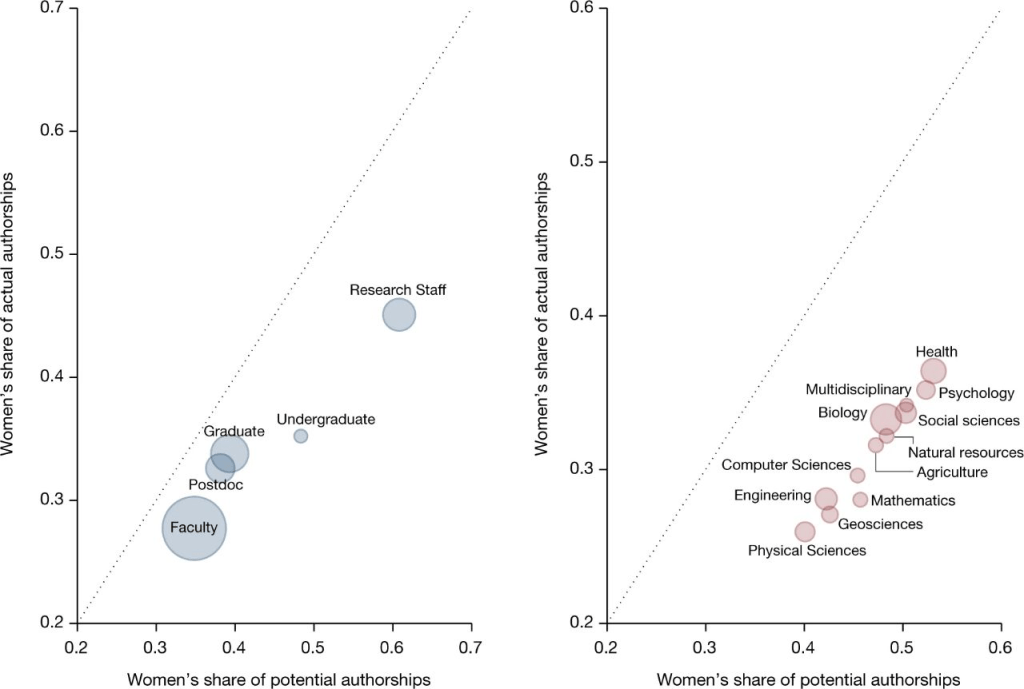
Image: idp.nature.com
This graph shows that the share of actual authorship by women is lower than one would expect, given their share of potential authorship in each career position. It follows that women are systematically less likely than men to be named as the authors of a particular article or patent.
There is also a definite connection between the citation of articles authored by women. When taking into account the field of activity, career position, and team size, there is no significant difference between the likelihood that a woman’s name will be mentioned compared to a man’s in a zero-citation article. However, in the more cited articles, women are mentioned less often than men.
The proportion of women in each position also decreases as the seniority of the position increases. The images use information about the position of each person in the organization—teachers, postdocs, graduate students, undergraduate students, or researchers—as well as about the field of activity of the research group. On the graph, we see that only about 35% of the teachers are women. And, at the same time, women make up just over 60% of the research staff.
The people interviewed in the study also note that the lack of recognition and proper attention is of great importance for a career. For example, one of the female respondents made the following comment:
“Authorship is crucial for career advancement; however, when interns are excluded from authorship by a senior author’s decision, there is no appeal or challenge process… Most of my fellow scientists (especially women) have suffered from faculty members who decide to assign authorship to other laboratory staff who did not do the work.”
Fighting gender inequality
It is obvious that gender discrimination in the scientific field strongly hinders the development of science and technology. When women do not have equal opportunities for education and career growth, society misses out on valuable ideas, perspectives, and innovations that could have been brought by them. The fight against gender discrimination contributes to the creation of a more diverse and inclusive scientific environment, which in turn contributes to better research and progress in science and technology.
In order to combat gender inequality in the scientific field, it is necessary to conduct training programs and trainings on awareness of their biases. It is important to implement an equality policy that ensures equal opportunities for women in STEM, as well as create supportive environments for female researchers where they can feel comfortable and protected.
In addition, it is important to promote women scientists to senior positions in order to provide them with equal career opportunities. Such measures will help create a more equal and inclusive scientific environment where women can successfully develop and contribute to science and technology.
Translated from Russian (s-z-n.ru, November 2023) by Viktoria Vovkotrub
Cover photo: http://www.deccanherald.com
 DiliTimes
Leave a comment