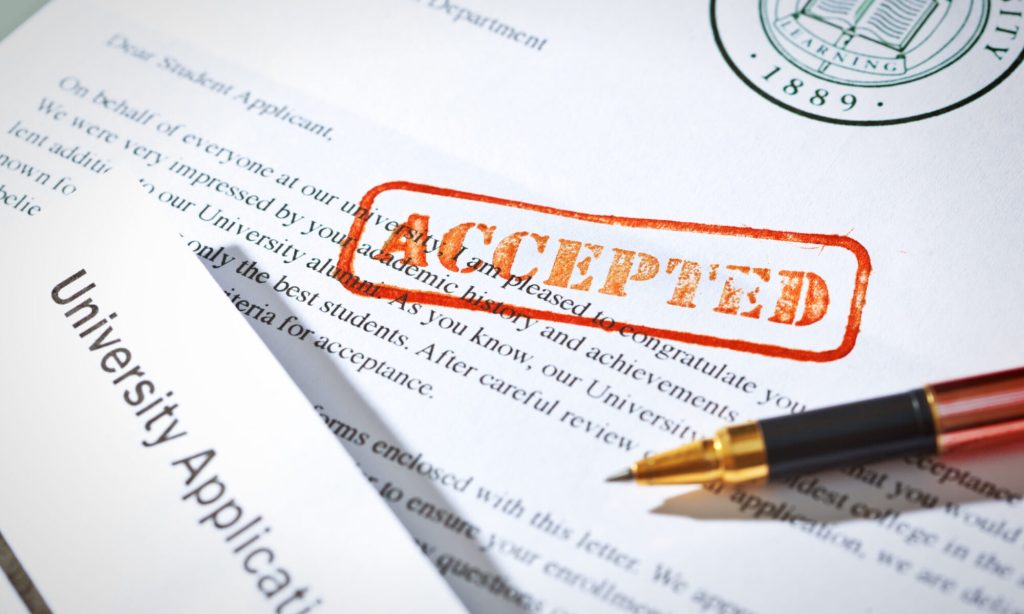
You finally open the letter of acceptance that says, “Congratulations! We are glad to inform you that you’ve been accepted.” The relief is immense, a confirmation that years of hard work, late-night studying, and stubborn ambition have finally paid off. The e-mail is proof you have achieved something extraordinary, and freezing for two years in the mountains of Armenia was worth it. After parents are told and friends and teachers congratulate you, another question arises:
Now what?
We are taught to treat acceptance letters as the solution to all problems experienced during high school. We imagine that once we reach that moment, everything will fall into place and we’ll finally feel successful. What follows instead is a mix of relief, anxiety, and confusion. Psychological research suggests that this response is not anecdotal. Most high-achieving students experience imposter syndrome, a persistent sense that they do not deserve what they have achieved and they are faking their success, even when external validation suggests otherwise.
As it turns out, acceptance is a transition, rather than an ending, and there is unfortunately no guide for it.
“What did they actually see in me?”
The emotional shift is usually immediate for students who recently got accepted. Dan (Zhixing) Song, China ‘26, who was recently admitted into Yale, describes the moment as surreal rather than celebratory.
When asked what he actually felt after receiving the acceptance, not just what he told other people, but what actually hit him, he answered the following:
“It was just wow; it was a huge disbelief because I thought there was no way. “Holy,” I thought to myself—but then I realized, “This is actually happening.“
The disbelief doesn’t disappear with time. When asked what he hasn’t said out loud since getting in, Dan admitted:
“What did they actually see in me? Because I sometimes think, ‘Sure, thank you so much for admitting me,’ but if anyone asks me genuinely why I got in, with which talent, I don’t know, and that’s scary.“
Acceptance created a new kind of scrutiny, both from him and others. We asked what he wished people would stop saying to him now.
“… but you got into Yale. ” I really thank everyone who congratulated me so much, but the truth is term four is brutal, and I really don’t want to be demotivated by my admittance because it can pretty much mess up a lot with the projects and academics that are ongoing.“
In a culture of gratitude, achievement is thought to cancel out stress. This is why admitting uncertainty seems inappropriate, even ungrateful. The guilt is familiar, and when asked if he felt guilty for feeling unsure after getting accepted, Dan replied:
“Yes, so much actually, especially because a lot of projects I’m doing are clashing with term four, which I need to study for, and this is a controversial take, but I don’t feel like school has prepared me with the skills to get my IB predicted.“
For many students, getting into college has long been their top priority. The issue of identity becomes inevitable once that objective is accomplished. When asked how the application process has affected his sense of self, Dan shared
“Great question! This is something I want to explore so much this term:
- Finding the relationships that matter to me;
- Finding what “unobstructed fun” means to me;
- Finding what I can give back to Armenia, even if in a small amount;
- How can I live a chill life?“
And when asked who he is without his acceptance, he answered simply:
“I am someone who doesn’t regret UWC, Armenia, applying to Yale, the walks to Inna, the late-night chats, and everything I’ve done so far.“
When the pressure doesn’t disappear
While current students experience these emotions in real time, alumni perspectives reveal that the pressure rarely disappears after acceptance. It changes shape.
Shayla Liette Hillis, US ’22, joined UWC Dilijan in 2020 during the COVID-19 pandemic and is graduating from Brown University in 2026 with a major in biochemistry. Looking back, she recalls feeling relieved after her acceptance, but not in the way she expected.
“When I got in (I applied early decision to Brown), I felt relieved, mainly because I was super excited and happy and because I didn’t have to continue the process of writing essays and applying to universities. I had a certainty in my future, so now I can plan for the next stage and focus on IB exams and summer plans. I did expect the relief, but it went away pretty quickly.“
That relief, she explains, did not translate into ease once university began. When asked what pressures followed her into university that she thought would disappear, she said:
“My first-year roommate got into UChicago in 2021, and I asked her if college is easier than the IB. She answered, saying that IB is the hardest thing she’s ever done in her life. And then I went to university, and I majored in biochemistry, and I applied to medical school in the US, and college was infinitely harder than the IB for me… The only pressure was that I thought that if I did IB, I’d be set, which turned out to not be true.“
Beyond academics, the transition brought an unexpected cultural shift. Asked what the hardest part of the transition from UWC to university was that people do not talk about enough, Shayla pointed to class and privilege:
“At UWCD, because I’m American, I felt very privileged… And then at university, being American wasn’t sufficient anymore… It was kind of like a different kind of culture shock, one based on class.“
The illusion that resilience at UWC guarantees ease later proved misleading. A new form of pressure and independence emerges. When asked what she would tell her past self on the day she opened her acceptance letter, Shayla emphasized audacity rather than reassurance:
“I think I would tell myself to set outrageous goals and then work towards them… just apply… things you don’t think you’ll get… Through the process, you will learn so much.“
And for current UWC students navigating the same uncertainty, she offered a measured reminder:
“Even though it is going to be fine, be selective about who reads your essays… We all have our own paths; we all do our own things… I understand from when I did it that it feels like this is all your world.“
Naming the in-between
Acceptance letters are celebrated loudly, while unfortunately what comes after is often experienced in silence. Students at UWC are prepared extensively for getting in but rarely for the emotional aftermath: not only the doubt but also the pressure to justify success and the identity shift that comes after it.
Perhaps the most important step is naming this in-between space in order to acknowledge that uncertainty does not invalidate achievement and success never eliminates struggle.
You will hear the phrase “It’s going to be fine” so many times throughout the next months that it’s going to sound empty. Still, take a walk to Café Number 2, drink an overpriced coffee, and don’t forget to pet Mish Mish. Not because everything is magically resolved, but because life continues in the middle of uncertainty, not after it.
Cover image: www.istockphoto.com
 DiliTimes
Leave a comment